
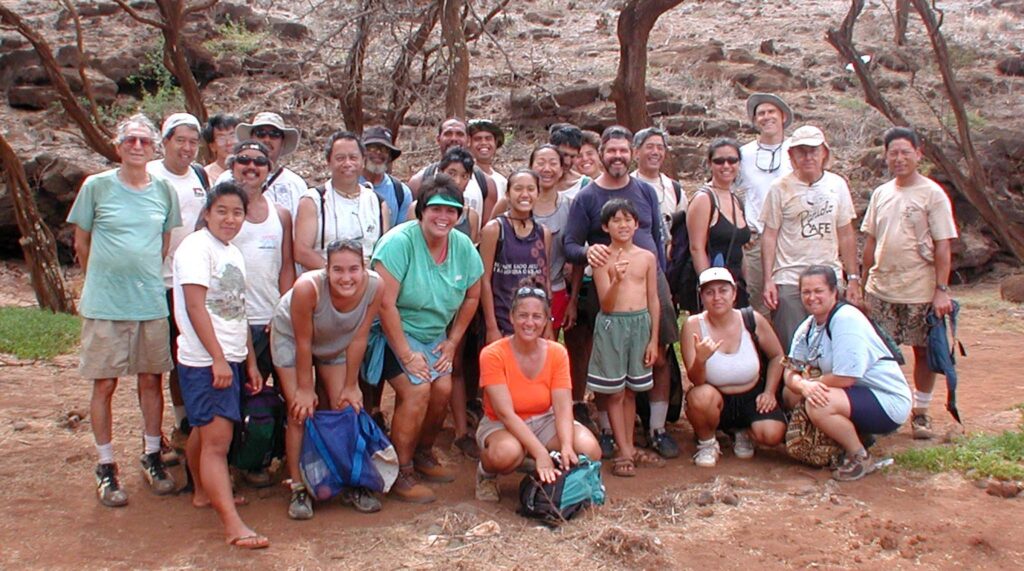
Three Native Hawaiian Health Scholarship recipients and two POL staffmembers are included in this photo of physicians, medical students, nurses, nutritionist, social workers, teachers, and health administrators at the end of a day-long hike. Aug 2001. Photo courtesy Kim Ku‘ulei Birnie.
KAHO‘OLAWE HEALING
This January we congratulate the Protect Kaho‘olawe ‘Ohana’s 50 years of awareness, education, and activism. And next week we celebrate the birthday of Dr. Noa Emmett Auwae Aluli. E ho‘omaika‘i!
Much has been written about the efforts to heal Kaho‘olawe: removing ordnance, catching and directing the rain, planting and reseeding. The island of Kanaloa Kaho‘olawe is also a healer.
Over the past 50 years, tens of thousands of families, community members, students and groups have participated in a 3- or 4-day access. Unplugged, there is but one agenda and everyone engages as a family, helping and caring for one another.
Huaka‘i participants camp, work, play and eat together. Everyone participates, according to ability. We learn how our ancestors lived, gathered and worshipped without modern conveniences and apply those lessons to wise resource management. For some participants, Kaho‘olawe is the first opportunity to practice Hawaiian culture and appropriate protocols.
Julie Oliveira-Payton—social worker and Native Hawaiian Health Scholarship alumna—once led a group of women in recovery across the choppy passage to Hakioawa’s rocky shore. With their therapists and their journals nearby, the wāhine immersed themselves in the elements, planted natives to restore the island’s vegetation, and became part of a collective that relied upon one another for sustenance and communion. It didn’t even take three days for these wāhine to see the island as a metaphor for one’s own resilience – years of trauma and abuse could be reversed with aloha, with community, with recognition of one’s own strength and self-reliance.
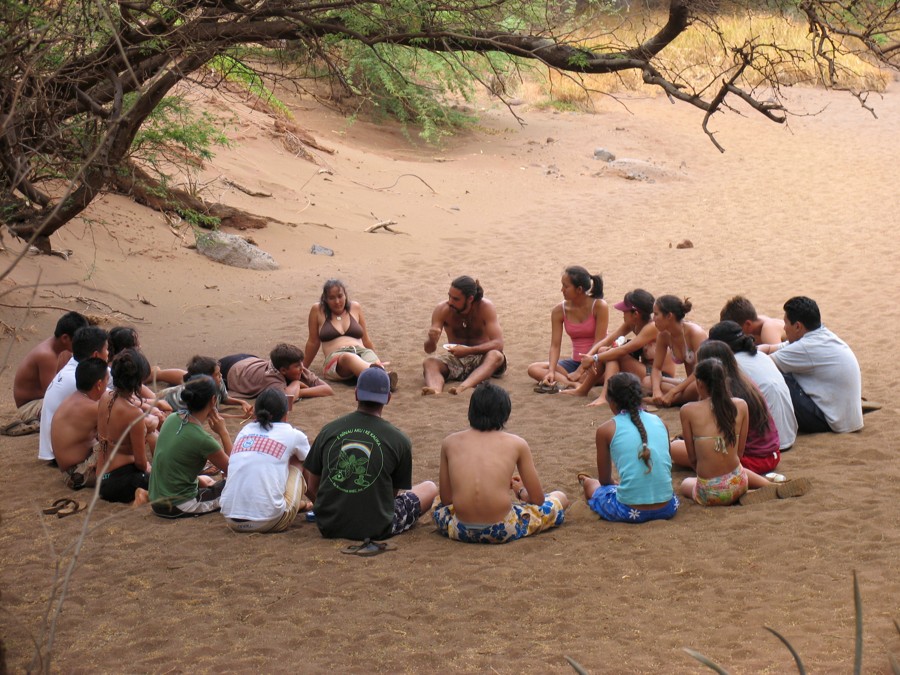
While wāhine and kāne gather near their respective heiau for kūkākūkā, the youth make their own space in the Hakioawa riverbed. Aug 2006. Photo by Derek Ferrar
Those experiences were replicated with other groups of men, of youth, also led by professionals in the Hawaiian health arena. Girls Court has facilitated healing opportunities on island. ‘Ahahui o nā Kauka has held continuing education sessions on island, physicians interacting with practitioners, blending clinical and cultural teachings in their curricula. And a huaka‘i used to be part of Papa Ola Lōkahi’s research interns’ training each summer.
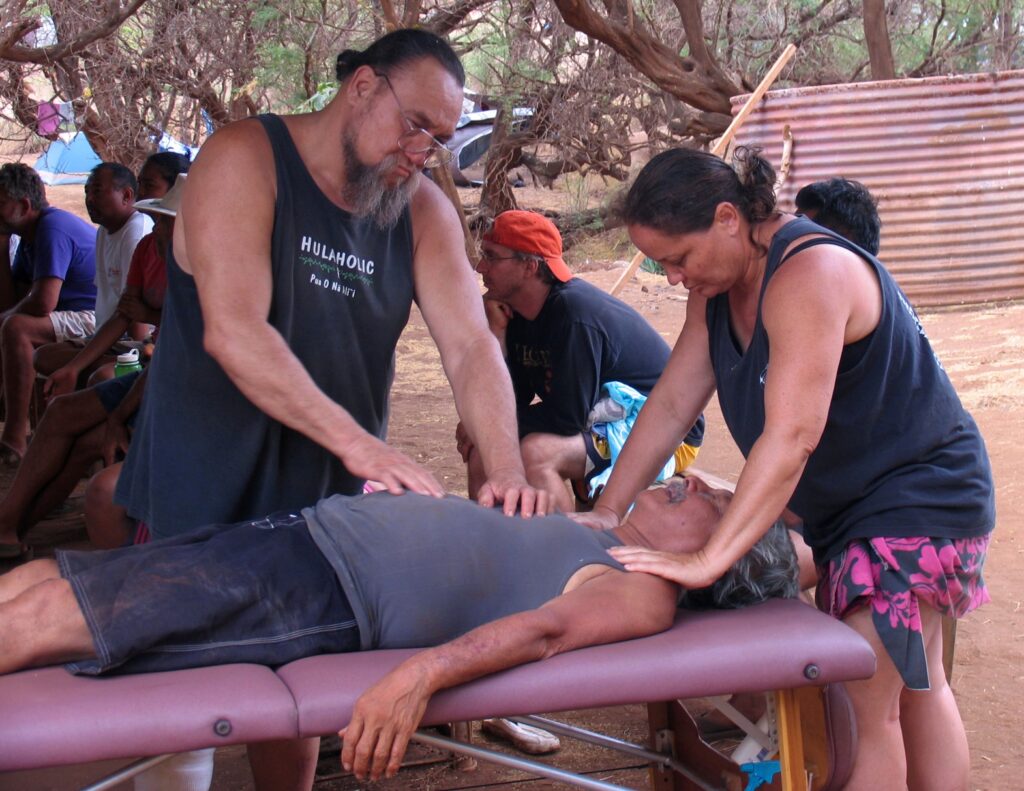
Cross-culture, cross-discipline. Practitioners Lei Bright and Alva Andrews work on Dr. Emmett Aluli. Aug 2006. Photo by Derek Ferrar.
In preparation for the Native Hawaiian Health and Wellness Summit in 1998, the people of Kaho‘olawe deliberated and identified the health and healing aspects of Kaho‘olawe. The brief can be found here. Others have analyzed the resilience factors of the Kaho‘olawe experience.
‘Ohana member Palikapu Dedman asserted that health should be a priority for Hawaiians, No leader wants to lead a nation of sick kānaka.
Emmett understood the depth of the island’s impact on individuals, Healing an island, healing a people, healing a nation.
E ola Kanaloa Kaho‘olawe! E ola mau!